Abdullah bin 'Umar (radi Allahu anhu- may Allah be pleased with him) said: A man asked the Prophet (sallalahu alayhi wa salaam - peace and blessings be upon him) "What is the best act of Islam?" He said, "To feed others and to give greetings of Salam (peace) to those whom you know and to those whom you do not know."
Ekhart, IN from the Amtrak train, September 2012
This morning on the CAT bus from Carlisle to Harrisburg, I was reading The Fortress of the Muslim prayers and hadith. I read this one (above) a couple of times over. And then I jumped off the bus to rush around and prepare my visa application.
Before I left the bank, I asked the teller about the Post Office's photocopier. Immediately, she offered to make my copies for me. I insisted that I needed an excessive number of copies, and it would be too much to ask. Eventually, the manager got involved, and she spent a good deal of time make every last copy that I needed.
After putting the application in the mail and hour or so later, it occurred to me that I should thank the kind staff at the bank. I was directed to a Harrisburg bakery called Ciao! and ordered ten giant cookies to be stuffed into a box. The cookies were so enormous that the box couldn't close. And then I went back to the bank, and offered the sweets to the staff there. They were not expecting such a gesture, at all.
When I left, feeling light and smiling, I just felt that this is Islam. Islam is not killing ambassadors and destroying property, but Islam is feeding people and making them happy, whether I know them or not.
Today, 2 September 2012, marks 1
year since my paternal grandmother, my Granny, passed away. I am her
namesake. My legal name is precisely the same as hers, first middle and last.
When I look at her headstone, the name that we share stares back at me.
Like
many other American girls, I've had my fair share of opportunities to
imagine myself with a different surname. Perhaps if I married this one
or that one, my name would change to this or that. We started imagining name changes in elementary school! Since then, I've observed
countless friends marry and take their husbands names, keep their names,
hyphenate their names, and so on. But now, I am sure that my father's name
will remain with me for my entire life; Muslim women do not change their
surname at the time of marriage. Aside from the part of me that occasionally wished
to distance myself from what it means to be a 'Thompson', I am pleased
to bear my grandmother's name without alteration. Her first name is not
common, but is quite versatile across cultures, and most Americans have
positive associations with the name Pauline. Elizabeth is my sister's
name, and it is also carries a strong and beautiful connotation. My mom loves the name Elizabeth, more than the name Pauline. I was named Pauline out of respect to my grandmother, as is customary in Greek culture.
At
the same time, over the past several months I have developed a feeling
that the name 'Pauline' does not capture well enough how I have changed,
and who I am. When I said 'Shahada' and publicly professed my commitment to Islam at the London Central Mosque
last year, the Sheikh gave me the option of selecting a new Muslim
name, but made clear that this is not compulsory. Until now, if other
Muslims ever expressed their opinion that I should change my name, I
defended my decision not to confidently. I'm aware that keeping or
changing my name is entirely my choice, and that Islam does not require
that I do so.
With
that said, the rootedness of my name in the Christian tradition,
especially its strong association with the Apostle Paul is causing me
increasing discomfort. I have developed a yearning to be called a name
that is rooted in my faith and inspires me to live my life as a good
Muslim woman. I have flipped through books listing Muslim names and
their meanings, but honestly, this is not my style. I realized that I did
not want to choose a popular name, or one that draws a lot of
attention to myself. I needed something with meaning that is significant
and inspiring to me, but simple for others to learn and say.
I
recalled the story of one of the wives of the Prophet Muhammad صـلى
الله علـيه و سـلم. I originally heard her story as part of a Mothers of the Believers series,
which I've mentioned on this blog before. I remembered hearing about
Umm Salama's (meaning the mother of Salama, her son; radi allahu anha - may Allah be pleased with her)
conversion to Islam, and her experience fleeing with her husband at the
time (Abdullâh ibn Abdulasad) from Mecca to
Abyssinia. She was one of the earliest converts to Islam, maybe the
fourth woman to convert. Although she was from a well-to-do family and
had a wonderful relationship with her family prior to her conversion,
she experienced a great deal of harassment from her family afterwards. They changed their behaviour towards her entirely,
and I understand well how terrible that feels. Not only that, but the
Meccan atmosphere was hostile to the new Muslims, so she became one of
several refugees to Abyssinia, where they were protected by a Christian
king. At times, like during Ramadan this year, I've had to leave my home city in order to worship in a supportive and nourishing environment.
Eventually
the refugees were misinformed that Mecca was no longer hostile to
Muslims, and she returned with a number of others, including her husband
and son. They quickly realized that Mecca had become even more dangerous
than it was when they first left, and were given permission from the
Prophet صـلى الله علـيه و سـلم to flee to Medina for safety. However,
when Umm Salama's family learned that her husband wished to take her
with him to Medina, they denied her the right to leave Mecca with her
husband, and separated her from her son. The woman was in agony, having
lost the love of her life and her child. Umm Salama was found weeping at
noon every day in the very place where her husband and son were
separated from her. She wept in prayer to Allah. She wept out of her
pain and desperation. She wept because she was loyal and completely
dedicated to her husband and child.
Over
one year passed before Umm Salama's prayers were answered; finally her
family granted her permission to travel to Medina with her son to
reunite with her husband. She did not spare a moment - Umm Salama set
out on foot with her son, intending to walk the entire three hundred
miles to Medina. When asked by the non-Muslim 'Uthmân ibn Talhah about the purpose of her journey, she stated clearly "I want my husband in Medina." 'Uthmân
ibn Talhah asked if she was travelling alone. Umm Salama boldly
proclaimed that was she was not alone, as Allah was with her and her
son.
I
greatly respect Umm Salama's awareness, even in hardship, of Allah's proximity and faithfulness. I resonate with her relentless devotion to
prayer and to the man she loved. Her ambitious intention to walk 300 miles
across the desert from Mecca to Medina cannot be matched. But the
passion she demonstrated reminds me of a night when I walked from
Colchester Town, England to Wivenhoe during a blizzard. Like Umm Salama,
when I was near Wivenhoe, a family stopped to give me a lift part of
the way. My journey was purely out of love and devotion, nothing
else. Interestingly, there's a similar story my father used to tell
about my mother setting out during a blizzard to be with him - the Maryland state
government had warned citizens to stay at home and off the
roads, but that didn't stop her.
Wivenhoe, Essex the next day.
Umm Salama was escorted to Medina by 'Uthmân
ibn Talhah, and enjoyed her reunion with her husband. Unfortunately,
after several years had passed, her husband suffered fatal injuries in battle. She was then
left alone without her beloved husband, and with her four children. She
received several marriage proposals prior to accepting the marriage
proposal of the Prophet Muhammad صـلى الله علـيه و سـلم . Perhaps she felt lonely, and it was hard for her to decide whether or not to accept the first or second proposal, just for missing the company of her husband. We don't know the details of her decision-making process, but we know that she demonstrated patience. She waited for the best proposal, not knowing whether it would come. Clearly the Prophet Muhammad صـلى الله علـيه و سـلم was the only one better than her beloved former husband.
She
warned the Prophet Muhammad صـلى الله علـيه و سـلم at the time of his proposal that she was a very
jealous woman. Actually, I've been told that her name carries a
meaning that is stronger than jealousy - it conveys the ability to keep
a man's heart. Umm Salama was known to be beautiful and intelligent. She often advised her husband in challenging situations,
and her advice proved incredibly beneficial to him. Also, Umm Salama was
known to fast and pray in the night. The Prophet Muhammad صـلى الله
علـيه و سـلم was known to pray in her home. She was a Hafiz of Quran (memorized the
entire Quran), and was second only to Aisha radi allahu anha in the
relation of Hadith. Umm Salama suffered extensively during her lifetime,
but she was strong and patient and had faith.
Umm Salama (radi Allahu anha) reported: I heard the Messenger of Allah (salAllahu alaihi wa sallam) saying, “When a person suffers from a calamity and utters: ‘Inna lillahi wa inna ilaihi raji’un. Allahumma ujurni fi musibati, wakhluf li khairan minha (Indeed, Oh Allah, to you we belong and to you we return. Oh my Lord give me the reward that is in this test and difficulty and cause me to receive after this difficulty something better than it.), then Allah surely compensates him with a reward and a better substitute.”
Knowing the story of Umm Salama, I sought to learn her name. I find her life and character to be inspiring and I resonate with her experience in even more ways than I've outlined here. I've decided to take the name Hind, the name of Umm Salama. Last week I met some new people, and in the moment I wished that I had a more appropriate name for them to call me. I've sought advice and have received the affirmation I wished for regarding this name. I am also sure that if the name Hind was not a good name, that the Prophet Muhammad (salAllahu alaihi wa sallam) would have suggested a better name for his wife, which was his practice. I'm happy that I can take this name confidently. My friends who call me Pauline will continue to do so. There's no need to tell my family about this name. But I hope to ask anyone I meet in the future to use it.
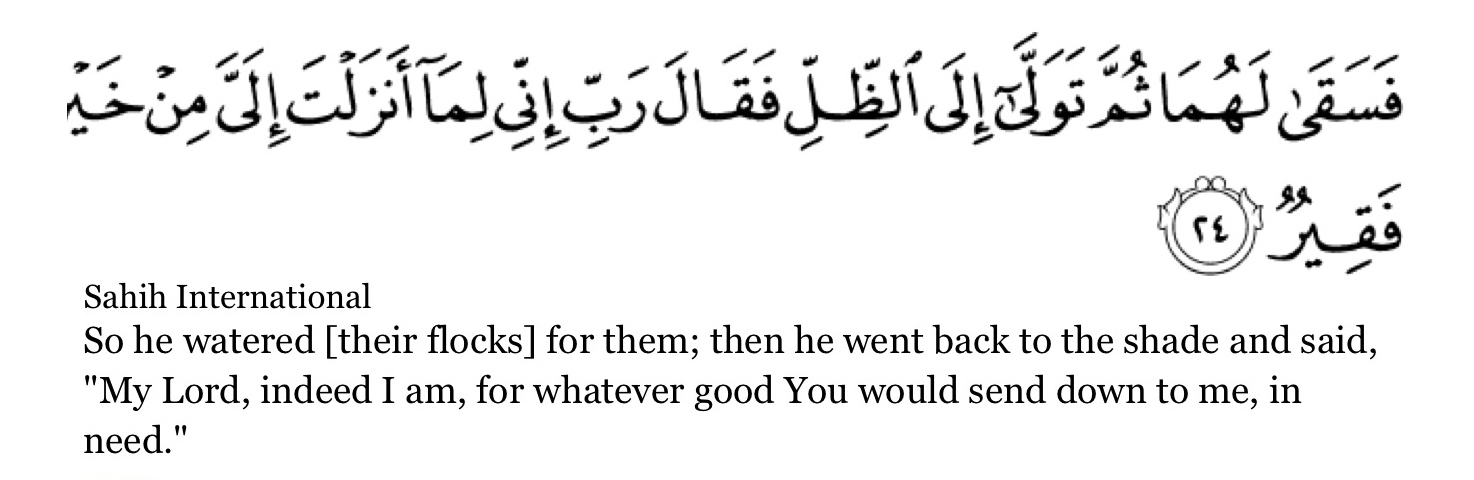
If I'm addicted to anything at the moment, it is Surah Al-Qasas. More specifically, I replay minutes 13:12 - 19:29 of the Mishaari Raashid with Ibrahim Walk [Saheeh Intl Translation] every chance I get. I pray the prayer of Musa (alayhi salaam) myself, kneeling with my hands open and flat in front of me. Even curling my fingers slightly would suggest that I am not entirely impoverished before Allah, the Lord of the Worlds.
Allah is merciful - my mom did not make a negative comment about my hijab when she picked me up from the station last night. A few comments flew at me today, but I want to be patient and kind. I miss smiling faces and friends in New York. The garment below was a parting gift from a dear lady from the masjid, who I love like she's my own mother. These traditional clothes she gave me are so beautiful, I find myself completely entranced by the designs.
I'm trying to learn how to be more generous. First, I learn by spending time with people who are much more generous than I am, who can exemplify generosity, and thereby, influence me to be more generous. Allah instructs us to give from our wealth, or our poverty, from whatever we have, despite our love for it. I think that my upbringing led me to have a hoarding mentality, where I always worried about giving too much, for fear of not having enough for myself. Allah acknowledges in Al-Quran that we may well love what we have, and that this love may cause us to hesitate to share. But Allah teaches that to be righteous, we must give away what we love, despite any worry or attachment to our wealth.
To be honest, I gave more during Ramadan than I'm used to. I gave to the masjid, I gave to people I knew who are in need. I spent money on food for Iftar, even when I was worried that I wouldn't have enough for my own food. You see, I tried, although I wasn't perfect. And I notice there's still some money in my account. Perhaps I can't believe it, or can't understand how.
So, today I made a small donation to Islamic Relief. I was going to donate to CAIR (Council on American-Islamic Relations), but I noticed that they have met their most recent fundraising goal. I don't have much in my bank account; I mean, I didn't have much even before I made the donation. But my actions (generosity) with little should reflect what my conduct would be with plenty. I want to give; I want to give as much as possible to as many who need it. Perhaps I didn't give as much as I should today, but eventually I'll learn to have more faith, to be more generous.
New York was a gift in countless ways. First, I had independence and privacy. I could fast without being harassed by my family in person about it. Second, how fortunate I was that Allah blessed me with an ideal summer job, which involved working in the mornings, and gaining experience for my upcoming escapade. The job allowed me to fast in an air-conditioned setting, without working a normal 9-5 schedule. I had time to spend at the mosque in the afternoon and evening. Third, I was with wonderful people throughout July and August. The kindest family, who accepted me and welcomed me and who I can't forget. And my dear friend Khadija, who I speak to more comfortably than I do my own sisters.
Just last week we sat chatting by the river in Jersey City at night, Manhattan shining in our view. She has this way of making me feel better, no matter how bad I feel. She always advises me to truth and patience, and therefore, has exemplified yet another essential aspect of Islam. Allah says in Al-Quran, Surah Al-Asr:
By time, Indeed, mankind is in loss, Except for those who have believed and done righteous deeds, and advised each other to truth and advised each other to patience.
We sat by the river on the Jersey side, and we listened to Adhan and Surah Al-Qasas together. The beauty of Al-Quran being recited at night by that river was profound to me. I shared with her a favorite video featuring the beauty of Al-Adhan that I've been watching with joy for years now:
This morning I took time to convince myself that it was OK to eat, despite the sun shining outside. Hah, it's strange to suddenly start eating and drinking during the daylight hours after having not done so for an entire month.
I love how huge the syrup in the picture (above) looks in proportion to the pancakes and two scrambled eggs. Ironically, the syrup was probably the smallest of all. I enjoyed a delicious lunch of 3 blueberry pancakes and eggs with dear friends this fine Eid afternoon at The Vinegar Factory. Not much beats pancakes over delightful conversation on Eid.
As soon as I walked into the masjid (mosque) this morning I was recruited to collect Zakat Al-Fitr and charitable donations from the women coming for Eid prayers. Thankfully, my task was not terribly difficult, as the Zakat Al-Fitr box was only meant to remind anyone who had not yet paid $10 of Zakat to do so. Technically, Zakat Al-Fitr should be paid prior to the first of the Eid prayers at some point during Ramadan, and if the deadline is missed, it cannot be made up. Nonetheless, it is important to give Zakat Al-Fitr as soon as one is able. As is stated in the Zakat Al-Fitr Wikipedia article, The Prophet of Allah
said that, "The fasting of the month of fasting will be hanging between
earth and heavens and it will not be raised up to the Divine Presence
without paying the Zakat al-Fitr." Mine was given directly to someone in need; it is not necessary to pay Zakat through the masjid.
The mercy of Allah astounds me. Eid is the day when the reward for fasting Ramadan is distributed. If the fast of one person is accepted, Allah forgives the sins of the entire congregation. Allah is abounding in mercy, and is looking for every possible excuse to bestow this Rahma (mercy) on us. Several hadith point to the mercy of Allah, even after those who sinned on earth are denied heaven.
Abû Sa'îd al-Khudri reported that the
Messenger of Allâh (saw) said,
"Allâh (subhana wa ta'ala) will admit the people of
Paradise to Paradise and He will admit whomsoever He will by His Mercy. And
He will admit the people of Hell to Hell, then He will say, "Look for anyone
who has the weight of a mustard seed of faith in his heart, and bring him
out"". [Sahîh Muslim, Kitâb al-Imân, Bâb Ithbat ash-Shafa'ah wa Ikhrâj
al-Muwwahhadîn, 1/172]
Anas ibn Mâlik reported that the Prophet (saw) said:
"Whoever says Lâ
ilâha illâ Allâh (there is no God worthy of worship but Allah) and has a barely grain's weight of goodness in his heart
will be brought out of the Fire. Then whoever says, "Lâ ilâha illâ
Allâh" and has a wheat grains weight of goodness in his heart will be
brought out of the Fire. Then whoever says, Lâ Ilâha illâ Allâh and has
an atom's-weight of goodness in his heart will be brought out of the Fire".
[Sahîh Muslim, Kitâb al-Imân, Bâb adna Ahl al-Jannah Manzilatan, 1/182]
Never, however, can we take the mercy of Allah on us for granted. Quite the opposite! We must constantly express our gratefulness to Allah, and be thankful servants, following the example of our Prophet Muhammad (sallalauh alayhi wa salaam - peace and blessings be upon him).
Narrated Al-Mughirah: The Prophet (peace and blessings be upon him) used to offer night prayers till his feet became swollen. Somebody said to him, "Allah has forgiven you your sins of the past and the future." On that, He said, "Shouldn't I be a thankful slave of Allah?" [Sahih Al-Bukhari, 6/4836 (O.P.360)
Prayer area for the imam downstairs at Islamic Cultural Centre of NY. Children like to hide hear during Tarawih prayers. No one is restrained from entering this space, unlike the Orthodox church, for example, which restricts the altar area to men.
After passing a lovely morning and afternoon with very dear friends, I enjoyed the evening with my Moroccan friend Khadijah, who I speak to most naturally, as if she were my biological sister. We enjoyed salads and bread at Le Pain Quotidien, and watching the sunset at The High Line. The picture does the beauty of the sunset and atmosphere no justice at all, unfortunately. Together we rejoiced over the happiness we experienced this Ramadan, the gift it was.
Back to fasting tomorrow (Monday), as it is recommended to fast 6 days of the month of Shawal. Thawbaan said that the Messenger of Allah صلى الله عليه وسلم said: "The
fasting of Ramadhaan is equal to ten months and six from Shawaal equal
two months so together they are equal to a year of fasting". If I'm going to fast 6 days of Shawal, I prefer fasting away from home.
I consider it a gift, almost a personal gift, that the moon was not sighted in Mecca on Friday, allowing Muslims to fast one more day of Ramadan. The month of Ramadan is usually 29 days in length, but this year extended to 30. The extra day gave me one more chance to pray, one more chance to fast and express my sincerity. The extra day was an opportunity to read the Quran for hours on Saturday - this month I've been so busy teaching and preparing Iftar at the masjid (mosque) on a daily basis, I remain two days behind on my goal to complete the Quran before Eid. It's probably shameful for me to admit that here, but such was my experience this Ramadan.
I loved the entire month of fasting and praying. Abstaining from food and water is not hard as some would suggest. Of course there's discipline involved, and even more, the mercy of Allah, who makes it easy for us. But for me the greatest challenge was the physical exhaustion due to a lack of sleep. Staying up late for Tarawih prayers and to rehydrate, on top of planning lessons to teach really took it out of me. Let's just say this is the first time I've ever fallen asleep while having my face threaded. To fall asleep during such an uncomfortable ordeal told me a lot about how tired I really am. Thankfully, the 30th day of Ramadan also made it possible for me to sleep until 10:00, which felt absolutely refreshing. What a gift from Allah subhana wa ta'ala.
It's hard to describe the heaviness I felt in my heart yesterday evening, and even in my physical body, as I soaked in the reality of Ramadan's end. Most Muslims will be celebrating with their families, while my family criticizes my fast and religion. I should at least say that I am grateful to Allah for allowing me to feel this month like I had a family. The beautiful traditional Pakistani dress of green and gold that I'm wearing this morning is evidence of how warmly I have been embraced this month.
I've taken a shower, dressed in my newest and best clothes, and eaten an odd number of dates. I'm ready for my first experience of communal Eid prayers. I thank Allah for this chance, and I'm going for the earliest of the prayers (7:30am), because I'm ever so grateful to be in a place this year where I am free and able to go to the mosque.
During Ramadan, especially during these final ten days of the month, Muslims strive to increase our good deeds and worship. This includes sharing resources and donations very generously with each other. Almost every time you turn around someone is donating to the masjid (mosque), giving Sadaqah (charity) to anyone in need, paying Zakat (almsgiving that is one of Islam's Five Pillars), volunteering their time to help others, or sharing food to feed those who have been fasting. The Prophet Muhammad (peace and blessings be upon him) said that 'Charity is the proof of our iman (faith)." If someone starts to make us angry, we are taught to say "I am fasting, I am fasting" as a reminder to stay focused on spiritual discipline, and that Ramadan is no time for disputes.
I am struck, سبحان الله (subhanAllah - Glory be to Allah) by how Allah has blessed our masjid with wonderful food for Iftar. Especially in the past few days, we've felt the increase in the community's generosity. I am deeply saddened whenever I hear a select few of the community complaining about the food, as if there is not enough. It is haram (prohibited) to be ungrateful, and is shameful behaviour during Ramdan. This month is an incredibly important time to remember the needs and hunger of the global Muslim community, and to respond with generous donations to organisations such as Human Appeal International, Islamic Relief USA, and Muslim Aid.
The men's table of food for Iftar (breaking the fast).
Women's table of food for Iftar.
Our food for Iftar depends largely on what people bring to donate. Last night was 1/2 banana, some walnuts, watermelon, 3 dates, and donuts or bread. Another shot of the women's table.
White and sweet milk juice and water.
More dates and bananas that we prepared for Iftar.
A number of Muslims along the way have expressed that they find the requirement to abstain from food and water for such long periods to be cruel and unreasonable. Non-Muslims are usually particularly disturbed by Muslims abstaining from water for the majority of day, and during the hot summer at that. But the reality is that the Muslims feels inexplicable joy in obedience, despite thirst and hunger pains throughout the day, if we even feel them. I said before that I'm teaching and working throughout the day, and yet at sundown, my mouth is still moist. This is a gift from Allah. If the fast of Ramadan were too extreme a request, Allah would not require it.
Narrated Abu Hurairah (may Allah be pleased with him): The Prophet (peace and blessings be upon him) said, "Religion is very easy and whoever overburdens himself in his religion, will not be able to continue in that way. So you should not be extremists, but try to be near to perfection and receive the good tidings that you will be rewarded; and gain strength by offering the Salat (prayers) in the mornings, afternoons and during the last hours of the nights." [Sahih Al-Bukhari, 1/39 (O.P.38)]
Our prayer during these final days is a plea for forgiveness from Allah:
We learn that the names encapsulating Allah's profound willingness to forgive us imply that Allah is fully aware of our sins, and yet chooses to overlook them out of mercy. Not only that, but Allah's name Al-'Afuww (the Pardoner) when paired with Al-Ghafoor (the Forgiver), emphasises that Allah forgives no matter how great our sin. See Al-’Afuww: Who Forgives In the Last 10 Nights? on Allah's forgiveness during Ramadan and The Night of Power (Laylat’l-Qadr): Step by Step Guide. Our prayers for forgiveness our not merely words - we increase our generosity and good works and we increase our prayers to strive for forgiveness. We recite specific dua's (prayers) in remembrance of Allah, as a sign of our desperation and need for Allah's mercy (see Step by Step Guide above). Such guidelines for worship and prayers for forgiveness remind me of Saint Maybe, a book that I read back in college, in the sense that forgiveness is a profound relationship with the actions we take to earn forgiveness, and the mercy of God which makes forgiveness possible.
This recitation is that of a 22 year old Bangladeshi Imam who is reciting Quran during Tarawih prayers these last ten days of Ramadan at 96th St.
سبحان الله (subhanAllah - Glory be to Allah) I love listening to the recitation of Al-Quran. The best moments are when I hear portions of Quran that I have memorized and studied myself, and can appreciate the depth of meaning. But even when I listen to the Arabic recitation, I'm overcome by a strong sense of the miracle and gift that is the Quran. I lady I met recently commented that when she reads the Bible she feels too distracted by the number of writers and their humanity involved in the text. This is a major difference to me between 'reading' (or listening to) the Quran and reading the Bible. The Quranic text has not changed since its revelation to the Prophet Muhammad (peace be upon him) 1400 years ago. The Quran is the same across all borders and sects of Islam. And Islamic scholars readily highlight the clear distinction between the language of Al-Quran, which comes from Allah, and the language of the Prophet Muhammad (peace be upon him) in Hadith (that which is attributed to the Prophet (SAW) as regards words, actions or approvals, physical features and characteristics). This distinction emphasizes that the language of Quran is not that of a human being, but that of Allah.
I looked up from the fruit that I was cutting in preparation for Iftar, and glanced into the masjid. Momentarily, my heart stopped. An all too familiar face appeared in the distance - he was chatting quietly with a brother in the prayer area. I only saw hair and eyes, as the rest of his face was blocked by the man seated in front of him. It wasn't him, in the end, but my reaction and surprise indicated to me that everything is still so fresh in my heart, and it all could just as well have happened yesterday. I pray to Allah about these feelings with my hands held open and flat before me. This Ramadan, I want to heal, by any means Allah chooses.
An unforgettable sunset over a farewell tea at the University Quays in Colchester, Essex, England.
Often Muslims are described by the media and the public as extremists. When in fact extremism in any form is strongly discouraged in Islam. The faith is meant to be practical and reasonable and moderate. Islam provides spiritual guidance and endless number of prayers for every moment of one's life. Prayers for waking, for leaving the house, for entering and exiting the mosque, for after prayers, for before and after meals, for entering and leaving the bathroom, for sneezing, for before sexual intercourse, for sleeping, and the list goes on. Not to mention prayers for the remembrance of Allah, which are best recited one hundred times daily. But part of the beauty of Islam is that every individual and family and community strives to find the most reasonable way to incorporate such guidance into our daily lives, without becoming ostracized or losing touch with the surrounding culture.
Consider the following Hadith:
Narrated Abu Hurairah (may Allah be pleased with him): Allah's Messenger (peace be upon him) said, "The deeds of anyone of you will not save you [from the (Hell) Fire]." They said, "Even you (will not be saved by your deeds), O Allah's Messenger?" He said, "No, even I (will not be saved) unless and until Allah bestows His Mercy on me and protects me with His Grace. Therefore, do good deeds properly, sincerely and moderately, and worship Allah in the forenoon and in the middle of the afternoon and during a part of the night, and always adopt a middle, moderate, regular course whereby you will reach your target (Paradise)." [Sahih Al-Bukhari, 8/6463]
Maybe I'm inclined now to mention this, because I am aware that the audience here may feel a bit overwhelmed by the religious language I'm using to describe this spiritual experience. Plus, some of the language is reminiscent of Christian lingo that we've heard in the past. It's true that many beliefs and concepts are similar, which is part of the reason Islam has allowed me to incorporate aspects of my Christian experience that I had lost. It's been a sort of 'coming home' to become Muslim. Ultimately, the Muslim's objective is to practice the religion wholeheartedly, sincerely, and in moderation.
Last night at the mosque a young woman said Shahada and converted to Islam. She was surrounded by sisters in Islam, and everyone hugged and greeted her by saying 'Asalaam aleikum' (peace be on us) at the conclusion.
Also during Tarawih prayers yesterday evening, we were told that during the Quran recitation of the prayer, we would make sujood (bow touching the forehead to the floor) at a moment when we normally remain standing. After the prayer, I inquired further and learned that there are 15 points in the Quran, when Muslims are compelled to prostrate themselves [perform Sajdat al-Tilaawah (Prostration of Recitation)] at the recitation of those particular ayat (verses) whenever reading or hearing the Quran in Arabic. We encountered one of those ayat during the recitation of Surah Al-Hajj:
“See you not that to Allaah prostrates whoever is in the
heavens and whoever is one the earth, and the sun, and the moon, and the stars, and the
mountains, and the trees, and al-dawaab (moving living creatures, beasts, etc.), and many
of mankind? But there are many (men) on whom the punishment is justified. And whomsoever
Allaah disgraces, none can honour him. Verily! Allaah does what He wills.”
I was told that one reason for Sajdat al-Tilaawah is for the Muslim to contrast the behaviour of Iblis (Satan), who was unwilling to prostrate before Adam (peace be upon him) when Allah commanded Iblis to do so. The Muslim demonstrates complete and willing submission to Allah through Sajdat al-Tilaawah. I have yet to verify this explanation with Hadith. Nonetheless, I am happy to have learned something new!